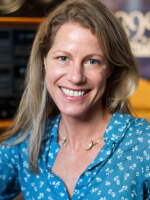




In Louisiana, a state known for its wetlands and industry, environmental education can shape how young people see the world around them — and their power to change it.
Reporter Aubri Juhasz follows teachers who are making science meaningful, from testing river water to calculating the carbon footprints of major companies. Last year, the state ended its environmental education commission after more than 30 years. Now, whether students learn to ask why, gather evidence, and connect the dots can depend on who their teacher is.
CREDITS
This episode was reported by Aubri Juhasz and hosted by Executive Producer Carlyle Calhoun. This episode was edited by Eve Abrams. Fact-checking by Philip Kiefer. Our theme music is by Jon Batiste, and our sound designer is Emily Jankowski.
Sea Change is a WWNO and WRKF production. We are part of the NPR Podcast Network and distributed by PRX. Sea Change is made possible with major support from the Gulf Research Program of the National Academy of Sciences, Engineering, and Medicine. WWNO’s Coastal Desk is supported by the Walton Family Foundation, the Meraux Foundation, and the Greater New Orleans Foundation.
____________________________________________________________
TRANSCRIPT
ACT I
A busload of thirteen and fourteen-year-olds, crunch down a gravel road outside Baton Rouge.
Some are sweating, wearing sweatshirts they refused to leave on the bus.
It’s February, but the temperature is in the 80s, hot even for Louisiana. Their teacher, Tyler Colson, says she warned them.
TYLER: I told them… Middle school.
They’re walking to the Amite River to collect and test water samples to see if the larger watershed is safe to swim in.
The nature preserve they’re at is hundreds of acres and has multiple trails lush with native trees. Cypress, birch, mulberry.
TYLER: Growing up… I never knew any of this was out here.
Tyler is from the city and teaches science at Park Forest Middle School in North Baton Rouge. She brought all of her school’s eighth graders on this trip.
TYLER: One child has been here out of all 35 of them, and that's really sad to me because this is about a 10-minute drive from the school.
Her students are Black — like her — or Hispanic. Almost all of them are low-income.
TYLER: They don’t get to do anything like this, especially being like the school that we come from, cause we’re the only F middle school in Baton Rouge. Everything is so focused on like tests.
The only F middle school. Like students, public schools in Louisiana also get grades. It’s based on those tests Tyler mentioned. State exams. What her students spend most of the school year preparing for.
TYLER: Test, test, test, test, test. Especially second semester. So I wanted them to get something like real hands-on, especially when it comes to like thinking like a scientist. And doing scientific stuff, they don’t get that. They just hear about it.
Louisiana’s science guidelines recommend this kind of teaching — getting out of the classroom, into nature to do actual science.
But schools aren't graded on it. So, Tyler says it isn’t really a priority. Field trips are rare. This is the only one her class will likely take this school year.
Tyler calls over a student named Tevoris [vors] Wilson. He’s kind of the class clown.
TYLER: Come talk. No. Come here. You’re not in trouble.
She asks him what he thinks they might find in the water that you wouldn’t want to swim in.
TEVORIS: Algae?
TYLER: Yeah.
TEVORIS: Or what?
TYLER: Poop.
TEVORIS: Um, poop. Oh yeah, poop.
Poop. Definitely something you don’t want to swim in. When we get to the river, the formal lesson begins.
TYLER: OK, y’all listen up. Listen up. Remember, what did we talk about in the thermal energy unit?
A tall girl with glasses raises her hand.
TYLER: Go ahead Peyton.
PEYTON: You can swim in the water if… FADE UNDER
Peyton says if the water doesn’t warm up enough to kill the germs, they’re still able to breed and succeed.
TYLER: Right… so I want us to break into groups of five.
Tyler gives each group a test kit. They all measure different things.
Tevoris doesn’t want to get his Nikes dirty, so he hands a vial to a classmate and tells her what to do. His group tests how clear the water is.
TEVORIS: Fill this up completely.
STUDENT: Lemme do it.
TEVORIS: I gotta take off my shoes.
Meanwhile, Peyton’s group — all girls, some holding PURSES — measures the level of chlorine.
PEYTON: If you meet me in the middle, I think I’ll put 0.6 for my best guess.
STUDENT 2: Yeah. Meet me in the middle.
PEYTON: OK, SINGING Baby, why don’t you just meet me in the middle… FADE UNDER
Tyler waves over the students to help her with the bacteria test.
It’s for E. coli. Most strains are harmless. But high levels mean there’s probably poop in the water. And poop can carry other germs that make people sick.
TYLER: What y’all think? Because this is between yellow and green. I can’t tell.
PEYTON: I think it’s like a lemon-lime Gatorade.
TYLER: Do you think it’s harmful in there?
STUDENT 1: Probably?
STUDENT 2: Not really.
Eventually, all the groups gather around Kevin Mendoza. He has wavy hair, bangs that hang in his eyes, like he’s in a boy band. He writes down the results on a poster board.
KEVIN: I’ve got the post, the poster, alright.
TYLER: You have pH. OK. Anybody else? So I have chlorine, pH, nitrates, phosphates and the bacteria. Anything else?
Tyler has the students look up the safe ranges for each measurement. Kevin writes that down, too. They use that to make a decision.
TYLER: Alright. Would you recommend swimming here?
STUDENTS: No.
TYLER: Why?
STUDENTS: Because it’s not safe… FADE UNDER
They brainstorm why some measurements were too high or too low. People pee in the water. They have parties and leave trash. And there’s another reason. Kevin says something. It’s quiet. But Tyler hears it.
TYLER: Say it loud. What they spray on them lawns?
KEVIN: Weed killer.
TYLER: Weed killers, pesticides.
All these things pollute the environment.
The students now have data to support their ideas. That’s why they’re here. Tyler drives that home with a final question…
TYLER: You have to have what?
STUDENTS: Evidence.
TYLER: Evidence. Because nobody gonna take you seriously unless you have some evidence. Alright?
If you think there’s a problem. You have to be able to prove it.
As they head back to the bus, Kevin comes over to talk to me. He's the one student who's been to the river before. With his family.
KEVIN: Usually, when we do come here, we see a lot of Hispanic families, like Hispanic people here. ‘Cause I’m Hispanic as well, so I see they each come out here bring, they cook here, they swim here.
He used to live nearby, would play in the woods, fish in the river.
KEVIN: One thing I would see is lots of trash. Like a lot of trash would come down from the top into the downstream.
Diapers, pizza boxes, alcohol bottles. He tells me about watching a pelican chew on a Coke can. Kevin says people don’t seem to understand they might be ruining a place they enjoy.
KEVIN: They might not put that much mind to it, but then if more people don’t put mind to it, the small things they do, it’s potentially a big problem for the ecosystem.
It’s potentially a BIG problem for the ecosystem.
And it’s more than just individuals. It’s companies, too.
Tyler has brought her students to the river, not just for a lesson in personal responsibility — don’t litter — but in agency.
If you think there’s a problem, go get your evidence and SAY something. Raise alarm bells. Tell your community. Contact people in power and try to make things better.
CARLYLE: That’s Aubri Juhasz [YOU-hahs], a reporter with the Gulf States Newsroom, a partnership between public radio stations in Louisiana, Mississippi and Alabama.
You’re listening to Sea Change. I’m Carlyle Calhoun.
Aubri has spent the last year looking at environmental education in Louisiana. The state is known for its wetlands, but also for welcoming industry — timber, oil and gas, petrochemicals — selling its land and resources. Now, several data centers and a SpaceX launch site are in the works.
Aubri wanted to know if public school students learn about the relationship between humans, companies and the environment.
That’s how she met Tyler Colson, the teacher who just helped her students decide whether the water at the nature preserve was safe to swim in. Aubri continues Tyler’s story after the break to show how the burden of making environmental education meaningful to students falls on individual teachers.
That’s coming up.
ACT II
Tyler Colson didn’t dream of having a career in science when she was young. But her parents had a different vision.
TYLER: I remember my mom told me, like, she had me repeat this mantra, ‘My name is Tyler Colson, and I’m going to Massachusetts Institute of Technology.’
This was when she was in ELEMENTARY school.
TYLER: It was just so ridiculous.
Tyler’s father was an engineer, and her parents wanted her to also have a career in STEM: science, technology, engineering and mathematics.
TYLER: But I always struggled in math. I was a reader. And my dad would tell me, ‘Hey, Tyler, if you wanna be in STEM, you have to know this math. You have to love math.’ So I immediately thought, ‘Oh no, this is not for me.’
In college, she majored in English. Until a professor intervened.
TYLER: He was like, ‘You might be interested in history because you’re so concerned with the why.’
The WHY is what eventually led her to science. And it became her north star as a teacher. Her first job out of college.
Even though she was a history teacher at Park Forest Middle School, she also taught science electives because they needed someone, and she was curious, learning alongside her students.
TYLER: How do drones work? Uh, how do I learn coding? And how do I learn aviation?
Her passion got her noticed. And eventually, she was recruited to teach at a brand new school.
TYLER: Eva Legard, which was an environmental sciences-based school.
The only school like it in Baton Rouge and one of just a few in the entire state that focused on environmental science.
It was a thought project of the district’s then superintendent. A press release at the time said the goal was to increase students’ awareness of environmental issues in the state and expand the pipeline of potential future scientists and researchers.
TYLER: It was open to any kid. Anybody could come, and it … I mean, be honest, it was in the hood. It was in the hood, and that was my hood.
The hood was in South Baton Rouge, not far from Louisiana State University.
TYLER: I just was in love with it. I was in love with the school.
Eva Lagarde was Tyler’s dream school, and she helped build it. A place where a strong science education gave students more opportunities. For college, jobs, to spend time outside.
Some of her students were recent immigrants from Honduras and were still learning English.
TYLER: They got hands-on experience with things that they would never, ever, ever have gotten hands-on experiences with.
Field trips were built into the curriculum rather than something she had to fight and fundraise for. She set up an aquaponics lab, where students helped her raise fish and grow vegetables.
Tyler was a social studies teacher. And because the school had an environmental focus, she taught environmental justice. She worked with local advocacy groups to plan lessons students could connect with.
TYLER: I want to bring in local issues to my students because they’re living in South Baton Rouge where it floods, right?’ The community knows if it has a note, let it float on Nicholson Drive.
If it has a note, let it float. Meaning if something isn’t paid off — like your car — don’t worry about saving it in a flood.
Nicholson Drive runs along both the Western edge of LSU's campus and historically Black and low-income neighborhoods. But only the neighborhoods are prone to flooding.
TYLER: Why is that? Why is LSU right there, and it’s supposed to flood, but it’s not flooding? Let’s get into that.
They talked about how people in power can decide to protect some neighborhoods by sacrificing others.
And how businesses can affect people’s health. Like the new Amazon fulfillment center in North Baton Rouge.
TYLER: It’s giving jobs to everyone in that community. But what are the environmental implications of that?
When it comes to industry, this is the tension, especially in Louisiana. People need jobs, but at what cost?
TYLER: So we had to have real conversations because, on one hand, I have students who have parents who work for Exxon, who work offshore. At the end of the day, we can talk about how much damage these companies are doing, but they have rent to pay, they have mouths to feed.
The goal was to get her students to think more critically about trade-offs. And how everyone in a community is affected.
She felt like the school was having a real impact on its students. Helping them think. Asking WHY.
But Eva Lagarde had a short life.
TYLER: Unfortunately, they were only open for three years.
Underenrolled, the school got swept up in a wave of school closures.
So Tyler went back to her old school, Park Forest Middle. Now she teaches eighth-grade science. Those are the students you heard at the beginning of the episode collecting water samples at the river.
TYLER: I’m still trying to incorporate all kinds of project-based learning.
But it’s hard. Remember, that was their only field trip that year. Kids don’t even get science every day, just two or three times a week.
Everyone I talked to for this story, educators and outside experts, told me Louisiana has pretty good science standards. That’s not the problem.
The state adopted them about a decade ago, as part of a national push to improve science education. Instead of memorizing facts, students are supposed to investigate, gather evidence and figure things out like real scientists. Exactly what Tyler tries to do with her students.
The standards include environmental science across grade levels. In seventh grade, they specifically bring up climate change. And that HUMAN activity is a major reason the Earth’s average temperature is rising. This is something some states leave out.
The problem in Louisiana.. is the GAP… between what’s on paper.. and what actually happens in schools. Standards are just words when states don’t back them up with resources and policies.
Tyler says she wants to teach kids how to think, not memorize material to do well on a test.
TYLER: That is what I hate. Just like, what is this rock name? Or how do we balance these equations? Why are we balancing these equations? What are we doing? Why, why do we care about the Earth? What does that mean for us?
Tyler wants science to MEAN something to her students — in their own lives. She wants them to ask WHY. So she designed her curriculum to make space for that. One example is a lesson she does on sound pollution.
She tells her students, go home. Close your eyes. Listen for five minutes and write down everything you hear.
TYLER: Oh my God, like, some kids, ‘I heard my m- my dad cussing out my mom. Um, I heard gunshots. I heard cars on the street. It affects my sleep. Um, I heard silence.’ Um, I really like that. So they start to think about how something as simple as sound pollution, which may be talked about in the science class, ‘Hey, there's sound pollution, blah, blah, blah. Let's move on.’ Nah, make it meaningful for them.
Tyler says her students often talk as though they have NO CONTROL over their environment or their futures. They’re resigned.
TYLER: I’ve worked in low-income schools for the past decade, and I get the same sentiments. Like, ‘Oh, I’m just a person. I’m just going through life, going through school and then I’ll go work at Amazon or something and die.
Go work at Amazon or something and die.
Tyler sees another path for them. She thinks her students have the power to change their communities. They’re an untapped resource.
TYLER: I don’t really think they know the impact or the power that they have. And it's another reason why I feel like it’s important to reach them as they are now.
While they’re young, at school.
A good science education matters, she says, because it creates informed, engaged communities.
And back in the 90s, the state of Louisiana agreed. Enough that they passed a law to try to improve everyone’s environmental literacy.
CARLYLE: You’re listening to Sea Change. Aubri picks up with what Louisiana did to improve how residents think and respond to local environmental issues. That’s after the break.
ACT III
The early 90s were a time of bipartisan support for protecting the environment.
The Clean Air Act was updated, and the U.S. Senate approved the United Nations’ treaty on climate change. Countries agreed to cut emissions, even though it wasn’t binding.
In Louisiana, teachers came together to push for more environmental education in schools. They formed a professional association and asked lawmakers to create a special commission to work on the issue. Which they did in 1993.
DINAH: It was represented by people from the education community, but also from business and industry, the state agencies.
Dinah Maygarden served on the commission for more than a decade. She started her career teaching in schools.
DINAH: I found the classroom to be frustrating, to be quite honest. I was never totally comfortable teaching in the classroom.
Like many teachers, then and now, Dinah felt limited. By what and how she could teach, in a system focused on test scores.
DINAH: I was young, LAUGH… and felt like this is not really what I want to be doing. I want to teach, I want to be effective, but I didn’t feel like I was being effective.
But she saw how powerful field trips could be. She remembers taking her class to the Audubon Nature Center in New Orleans East.
DINAH: I don’t remember what time of year it was. I know there was an alligator involved. LAUGH…
Out in the preserve, walking the boardwalk, she saw a huge change in her students’ behavior.
DINAH: From frustrated kids locked up in a classroom, to the natural curiosity coming out and genuine interest in learning for a moment, you know, while we were there.
Dinah says a lightbulb went off.
DINAH: That was an epiphany for me, I guess, you know it made me realize that I , you know, I really want to be outdoors teaching.
So Dinah left the classroom to teach OUTSIDE of schools.
For nearly 30 years now, she’s led environmental education programs out of the Pontchartrain Institute for Environmental Sciences. It’s part of the LSU system.
Dinah’s worked with thousands of people: kids, teachers and adults.
Coastal issues are a big focus.
DINAH: My takeaway always was that people didn't have enough information about those issues. Their knowledge was very vague and abstract.
Except for the people who are already out on the water, she says, like fishermen, shrimpers.
DINAH: It was really hard to feel like, oh yes, everybody I talked to really got it. And we’re making a difference.
Dinah joined the commission I mentioned earlier — the Louisiana Environmental Education Commission — in 2009. And later served as its chair.
The Department of Education’s website says the goal of the commission is to quote, “cultivate a Louisiana citizenry that understands, feels connected to, and is inspired to protect, preserve, and restore our environment for present use and future sustainability.”
Dinah says the commission’s main task was to develop a plan to increase environmental literacy.
DINAH: And that was a big enough challenge… LAUGH
First, they had to decide what it means to be environmentally literate.
DINAH: Basically, we would say somebody who has the skills to make good environmental decisions in their lives.
But also the knowledge to recognize environmental problems around them. Like litter or pollution.
DINAH: They would know what they were looking at and also be able to take action.
Exactly what Tyler Colson, the teacher in Baton Rouge, tries to do with her students.
I asked Dinah if the plan succeeded. Are Louisianans more environmentally literate now than they were when the commission was created more than 30 years ago?
DINAH: No, I don't think so. Generally, I mean, I think there’s I don’t think we can generalize though
Dinah thinks like a scientist and doesn’t like to say something unless she has the data to back it up.
The commission may not have transformed how Louisianans interact with the environment, but it did have an impact. One with a more trickle-down effect. It provided training for teachers — there was an annual conference — and resources for schools, lesson plans, grants for field trips and projects.
DINAH: It may not have been huge grants, but they got, you know, kids making gardens, starting recycling programs and all those kinds of wonderful, real things.
And the commission was a place — the only place — where people from different backgrounds were working together to try to improve environmental education and coordinate resources.
For most of its life, the commission was under Louisiana’s Department of Wildlife and Fisheries. Then, a few years ago, the state moved it to the Department of Education.
Dinah says that was the turning point. The Department of Education took away the commission’s budget and freedom, she says.
Jacqueline Richard [REE-chard], a geologist and college professor, was also on the commission and was its FINAL chair.
JACQUELINE: In just the very short, like two or three years that I was on the commission, we started having more and more lawyers in the room, um, really just kind of making sure that we were following the law, even though we weren't a commission that could really do anything.
They were no longer giving out grants or training teachers. Under the Department of Education, Jacqueline says the commission’s work... basically ceased.
JACQUELINE: It just became pretty clear at the end that they were kind of biding their time until we could be dismantled.
And that’s exactly what happened in the spring of 2025.
DINAH: I think we just got an email saying there will be no more meetings because the commission no longer exists.
Dinah says it isn’t clear what went on behind the scenes.
DINAH: I definitely felt like there were politics at work there, but I wasn't privy to what was driving the decisions that were taking place.
Jacqueline is more outspoken than Dinah.
JACQUELINE: It’s a big political system, education, unfortunately.
She isn’t exactly sure what happened either. But she thinks some officials see environmental education as a threat to the state’s business-friendly approach.
JACQUELINE: I think as community members become more aware of the environmental consequences of industries that we’ve had in Louisiana for the past, you know 250 years, the stronger the will of the people becomes against industries or, you know, righting wrongs of the past, and so it's just kind of easier to bury it.
She points to a state law passed in 2024. Which makes it harder for people to share air quality data they collect on their own or use it to take companies to court.
When I asked the Republican lawmaker who authored the bill that ended the commission WHY he did it, he said he didn’t see a need for it because it wasn’t doing much. Which by then was true.
He told me it was his idea, but he ran it by Louisiana’s Department of Education to make sure it was OK. And the bill says the department is supposed to take on the commission’s responsibilities.
I asked Louisiana’s Department of Education for interviews, so officials could explain the changes and the work they’re doing internally. A spokesperson told me they couldn’t fulfill my request and to send questions… which I did. But they didn’t answer them.
I spoke to another former commission member who told me she DOESN’T think officials are deliberately suppressing science education. Louisiana’s Department of Education has limited resources and its own priorities, she says. For example, the department has been focused on reading and math, and test scores in those subjects HAVE improved.
But there are consequences. The Department of Education recently decided to stop testing science every year. And this former commission member worries less science testing will lead some schools to teach LESS science.
Schools are still required to teach science every year from kindergarten through the eighth grade. Reducing testing is meant to lighten the testing burden… something many teachers want. But that doesn’t mean science won’t take a hit.
Jacqueline writes environmental science curriculum and works with teachers one-on-one. She says the vibe check from them isn’t good.
JACQUELINE: They're pretty much just using what's dictated to them, and it's not necessarily even being given to them with the full resources behind it. So to me that suggests that either environmental science is very low on the totem pole or just not important at all.
Although the Commission for Environmental Education no longer exists, the Department of Education's website still has the page up describing its mission.
It says, “Louisiana’s rich and dynamic environment encompasses a vast area of land, water, and culture that serve as the lifeblood of this great state. Making wise decisions about using these resources is therefore necessary for us to maintain both a healthy environment and a vibrant economy.”
Students in Louisiana can have VERY different experiences when it comes to environmental science, from district to district, school to school, even classroom to classroom. Some go on field trips, ask questions and connect what they’re learning to the world around them. Others don’t.
This problem isn’t new. But with the commission gone, there’s no longer a statewide group working on a solution or public acknowledgment that the problem still exists.
ACT IV
Students trickle into Jacqueline Richard’s 10 am class at Nunez Community College outside of New Orleans.
She’s animated, moves around a lot.
JACQUELINE: I always tell my students that I drink a lot of coffee, so this level of excitement all the time… FADE UNDER
It’s still early in the semester, and students are a little shy. A few are older, in their 30s. There are also some teenage boys from the local high school.
JACQUELINE: All right, y’all. You guys ready to get started? FADE UNDER
It’s an intro-level course that includes environmental science, physics and chemistry. Jacqueline described it as teaching the 13th grade, catching students up and helping them adjust to college.
She lectures from the back of the room while her students look at a screen up front. On it is a map of Louisiana with the state’s predicted land loss in blue.
JACQUELINE: If we don’t do any coastal restoration, everything in blue is what we’re gonna lose in the next 50 years.
It’s a lot of blue. Thousands of square miles all along the coast.
JACQUELINE: That’s pretty intense, right?
The students don’t really react. Jacqueline zooms in.
JACQUELINE: So let’s look at here; let’s look at St. Bernard.
That’s where we are. Specifically, Chalmette, a majority-white working-class area.
St. Bernard is known for its industries: shipping, commercial seafood, oil and gas. Jacqueline says the parish could lose more land than any other.
JACQUELINE: So we would lose about 72% of our entire parish. I want y’all to think about that for a second. What if y'all went home and 72% of your community just disappeared? Would that affect you?
A few students nod.
Some teachers are afraid to talk about climate change because of politics. But not Jacqueline.
JACQUELINE: OK, we’re gonna stick to the scientific facts, right, of what’s going on… FADE UNDER
She runs through the greenhouse effect: Humans pull fossil fuels out of the ground and burn them, releasing carbon dioxide. That adds more CO2 to the atmosphere, trapping more heat and driving up the planet’s temperature.
Warmer waters produce stronger hurricanes. And stronger hurricanes speed up land loss.
JACQUELINE: Now, can any one of us in this room solve the whole problem ourselves? No. Right? But we should understand what's happening so that way we can make informed decisions, right?
A semester-long assignment reinforces this. Students calculate their carbon footprint — how much carbon they produce — also a company’s carbon footprint. Then they compare the two.
Back in class, a few weeks later, Jacqueline checks in.
JACQUELINE: Which industry did you choose?
She goes around the room.
JACQUELINE: Say it louder. Stolthaven. Stolthaven. Palantir. Palantir. Apple. Apple. PBF Chalmette. PBF Chalmette.
Stolthaven stores liquefied natural gas and has a terminal nearby. Palantir's a software company. PBF Chalmette is a local refinery.
JACQUELINE: Somebody you hope to work for? Yeah. Just curious. Yeah. And my stepdad works there too.
Jacqueline tells her students figuring out a company’s carbon footprint won’t be easy. The data may be hard to come by. So they’ll have to do some digging.
JACQUELINE: Let's talk about our footprints…
Students filled out a series of questions online: How much they drive, fly, what they eat, how much energy they use at home, their shopping habits and more.
Jacqueline asks for a show of hands. Which of these contributed the most to their overall footprint?
JACQUELINE: How many was your home?
No hands.
JACQUELINE: Nobody? All right. What about food?
A cluster of hands go up.
JACQUELINE: Good. All right. Teenage boys in the room, that makes a lot of sense, right?
One of those teenage boys is Trent Baggese [buh-JEH-see].
TRENT: Like I said, my big thing was snacks. Like, the food category, that's where my biggest carbon footprint was. I was 80% worse in the world than everybody else.
Because of the snacks. Gushers, peanut butter crackers, chips.
Trent’s about to turn 18. He’s tall, loves playing basketball.
Before the project, he didn’t know what a carbon footprint was. Once he learned, he immediately thought of all the snacks he eats.
TRENT: That all goes through, like, manufacturers and everything.
Highly processed foods produce more carbon. The factories, packaging, shipping.
TRENT: If I reduce down on those snacks, I'm gonna help better my body, get better nutrition to my body, but also, like, kinda reduce the amount of, like, factory use and all of that that's getting put back into the snacks.
But other carbon-friendly changes can be harder to make. Like driving your car less when public transit isn’t reliable.
Jacqueline told me the goal isn’t to make students feel bad, just more aware. Some things are out of your control, so do what you can, and advocate for policies that give you better choices.
Trent will graduate from high school and from Nunez with an associate’s degree this spring.
He plans to join the military. Calls me ma’am every time I ask him a question.
TRENT: Yes, ma’am.
TRENT: Yes, ma’am.
TRENT: Yes, ma’am.
Jacqueline’s class might be the LAST science class Trent ever takes. He says it’s the FIRST time he’s really learned about the role humans play in the environment. The role HE plays. He thinks that’s something everyone should learn.
TRENT: The world is the world. Everybody has to live in it no matter what they think. The earth is the earth. Everybody has to walk it. Like I said, I was one person who didn't even think about a carbon footprint and all like that, and so if I'm learning about it now in college, most people don't go to college and everything like that, especially in the New Orleans area… And I think some people just don't know to understand. Like a lot of people say, "Oh, they don't care, they don't care," but sometimes they just don't know.
They need someone to teach them, he says. So they can connect the dots, not just in school, but out in the world.
TRENT: And so that's the thing. I feel like they aren't taught to understand those things.
In Louisiana, whether someone understands can depend on where they go to school, who their teacher is, and the science classes they did or didn’t take.
Teachers like Jacqueline and Tyler put asking WHY at the center of every lesson they teach. It’s their mission.
Other teachers — ones who simply teach facts — Jacqueline and Tyler don’t think they’re bad teachers. It’s the system — the education system AND the political system — that put science and the environment low on the totem pole.